
How project constraints shape a review of Pet Grooming Dryer: supplier questions for early research
Clarify the decision before comparing suppliers
A pet grooming dryer review becomes useful when it starts with the equipment context, not a generic list of features. System integrators should first define what the dryer must do, where the heating assembly will fit, and which operating conditions the supplier needs to assess. The first supplier question is simple: which requirements describe the complete dryer rather than one heater component?

Write down the available space, the intended air path, the inlet air temperature, and the required temperature rise. Include enclosure heat loss, ventilation, and moisture removal in the same brief. These conditions give a supplier a usable starting point. They also prevent a common mistake: treating wattage as a complete answer for the temperature around the pet. The captured application guidance states that airflow rate, inlet air temperature, and required temperature rise should be considered together, then validated in a complete dryer prototype.
Next, separate confirmed requirements from working assumptions. A confirmed requirement might be a defined supply voltage or a fixed mounting area. An assumption might be that the available fan can maintain the intended airflow after a filter or enclosure is added. Keeping those categories separate makes early discussions faster and reduces the chance of turning an untested design choice into a purchasing commitment.
Build a concise comparison framework
A practical comparison should follow the air path from inlet to outlet. Ask the supplier how air moves through the heating assembly, where temperature feedback is taken, and how ventilation removes moisture from the drying area. Also ask whether the proposed arrangement uses fresh air, recirculated air, or both. The exact airflow path affects which operating details belong in the review.
For a pet grooming dryer box, the most useful discussion is therefore broader than heater power. The official application page describes a fan moving air through the heating assembly and delivering it through the dryer outlets. It also describes temperature feedback guiding heater operation and ventilation removing moisture. This is the single application example to carry into early research; it explains why the box, fan, heater, and ventilation path should be discussed as one arrangement rather than as isolated parts.
Use a short supplier worksheet with one line for each decision point:
- What voltage and power are required for this design?
- What dimensions and mounting limits must the heater meet?
- How will lead wires and connectors fit the equipment?
- What airflow, moisture, and temperature conditions should be reviewed?
- Which items are confirmed, and which still require prototype validation?
This format keeps comparisons tied to the project. It also gives suppliers the information needed to discuss a suitable configuration instead of responding to a vague product label.
Ask about airflow, moisture, and maintenance conditions
Airflow restrictions deserve their own questions. Hair buildup, blocked filters, or reduced fan performance can restrict airflow and affect heat distribution. Ask where these conditions could occur in the planned equipment and how they should be included in the configuration review. Do not treat a nominal fan arrangement as proof that the assembled dryer will maintain the same air movement.
- Define airflow rate, inlet air temperature, required temperature rise, enclosure heat loss, ventilation, and moisture removal.
- Describe whether the air path uses fresh air, recirculated air, or both, and how air reaches the dryer outlets.
- Record hair buildup, blocked filters, reduced fan performance, humid return air, and condensation as operating conditions to review.
- Share available space, operating conditions, voltage, power, dimensions, mounting, wiring, lead wires, and connector requirements.
Moisture conditions should be recorded with equal care. Humid return air and condensation influence heater selection, so the supplier needs a clear description of the return path and the drying environment. This is not a request for a broad performance promise. It is a way to expose the conditions that may affect heater choice and protection requirements before a design is fixed.
Temperature control also needs a precise question. Ask what temperature feedback guides heater operation and where that feedback belongs in the complete assembly. Then record the required temperature rise and the inlet air temperature. A supplier response should be compared against those stated conditions, not against a wattage number viewed on its own.
Avoid unsupported conclusions
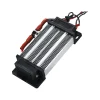
Early research often goes wrong when a listed specification is treated as a guarantee for every application. The captured page lists one 80mm PTC fan heater at 220V, 400W, and 106 × 80 × 53mm, with an integrated fan. Those figures describe that listed product. They should not be transferred to another model or assumed to prove suitability for a different dryer enclosure.
Use the same discipline with custom options. The supplier page states that voltage, power, dimensions, mounting, and wiring can be configured to fit a dryer. That supports a focused question about the available space and operating conditions. It does not, by itself, establish compatibility, safety performance, or results in a finished product. Those conclusions belong after the complete configuration has been reviewed and the selected heater has been validated in a prototype.
Carry the requirements into procurement
Before requesting a quotation or technical response, turn the comparison into a compact sourcing brief. Include the air path, airflow conditions, inlet temperature, required temperature rise, moisture conditions, available space, mounting method, wiring needs, and known electrical requirements. Mark each entry as confirmed, proposed, or requiring validation. This gives the supplier a clear boundary for the response and gives the project team a record for later decisions.
The best early supplier question is not “Which heater is strongest?” It is “Which configuration fits these stated air, space, moisture, temperature, and interface conditions, and what must the prototype validate?” That wording keeps the review evidence-led. It also helps system integrators compare replies without filling gaps with assumptions. PTCYIDU can be included in that process when the brief concerns a custom PTC heating assembly, but the final choice should remain tied to the documented dryer conditions and prototype review.