
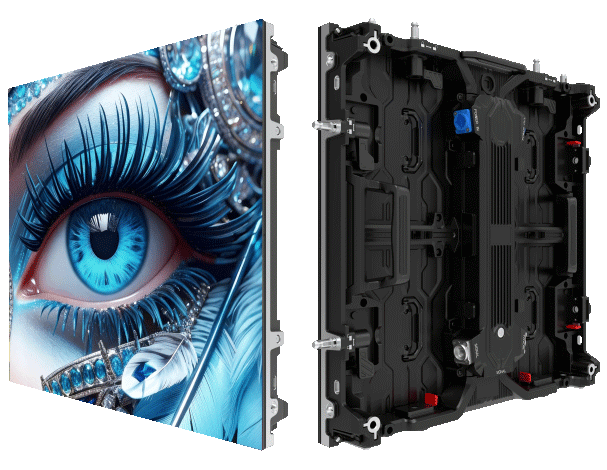
The problem in light
The great stage of an event asks for a single, honest image, yet wide-format curved screens often betray their own promise: colors that wash unevenly across a crowd. When planners rent a led display screen for a gala façade or a stadium wrap, they expect uniformity; what arrives can be patchy, dim at the edges, or warmed into sunset hues. This is not mere aesthetics. It is a clash of geometry and emission — viewing angle physics, pixel pitch choices and raw brightness fighting one another across a curved surface. Those same outdoor led screen panels must deliver consistent hue and luminance from dozens of angles, and failing that, content loses its voice on opening night.
Why curvature betrays color
Light from an LED module is not a flat proclamation; it fans, it weakens, it polarizes. A planar screen offers a predictable cosine falloff; a curve introduces variable grazing angles so some viewers see LED photons at a tangent while others take them head-on. That variance accelerates color shift and perceived contrast loss, and the effect grows with tighter pixel pitch and wider viewing angle specs. Engineers speak simply: as the effective viewing angle widens, spectral balance shifts and gamma interpretation diverges between seats. The math is plain and poetic — angles bend light and the eye translates that bend into color error.
Common mistakes that make it worse
Event teams make the same practical errors: choosing the smallest pixel pitch for its crispness without mapping viewing zones; cranking brightness to “fix” washed-out corners; or trusting default calibration profiles shipped with LED modules. These are not sins so much as shortcuts — shortcuts that reveal themselves under stadium lights. Calibration ignored is color betrayed; installation geometry left to chance becomes a visual sieve. Take the time to measure sightlines and map them to the screen’s emission profile — or pay for the rehearsal that points out the mismatch. — Little adjustments save large reputations.
Practical fixes and pragmatic design
Begin with hardware that understands curve: modular panels engineered for curved joins, matched emitters and consistent refresh rate to avoid banding across seams. Next, temper pixel pitch choices with viewing distance — finer pitch means more fidelity up close, but if the crowd sits in a broad arc, a medium pitch with superior angular emission often yields truer color across the house. Apply per-module color calibration and gamma mapping; use software to build angular brightness compensation maps that reduce edge drop-off. For outdoor rigs, add measured increases in nits at grazing zones rather than one-size-fits-all brightness; this conserves power and protects contrast. Finally, bond content design to the physical reality: keep critical skin tones and brand colors within the safest gamut for wide angles.
A real-world anchor
Look at the façades of Times Square or the giant festival screens at Glastonbury: they are practical lessons in scale. These installations routinely call out viewing angle specs in the 120°–160° range and staff teams that perform live calibration during soundcheck. Engineers there treat brightness, viewing angle and pixel pitch as a triad — match two and the third falls into place. That discipline is the simple context behind every successful outdoor spectacle: you cannot separate the display from its place in the crowd.
Golden rules for selection — three critical metrics
Measure three things before you sign the hire: angular uniformity (look for manufacturer emission curves and prefer panels with tighter off-axis color stability); calibrated brightness strategy (specify per-zone nit targets, not a single max number); and installation geometry tolerance (how well modules align when curved and the supplier’s track record with seams and refresh-rate syncing). Aim for these as non-negotiables and your event will hold color like a held note. For practical supply and support that respects those rules, consider a partner whose portfolio shows repeat success on large curved builds — a partner such as MR LED. –